


Background
Major challenges in psychiatry include time-consuming diagnostic processes with low inter-rater reliability and the lack of objective biomarkers. Furthermore, a significant proportion of patients do not respond to psychiatric treatments, with underlying reasons remaining unclear. Consequently, there is a critical need for objective biomarkers to enhance diagnostic reliability and to predict and index treatment responses.
SOCO is a project in collaboration with Robert James Blair, Søren Dalsgaard and Birgitte Fagerlund from the Research Unit - Child and Adolescent Mental Health Centre (CAMHC), Mental Health Services, Capital Region, tackling this
exigency for biomarkers in psychiatry. In SOCO, a novel machine learning approach is applied on neuroimaging (fMRI), to determine the neural response within specific neuro-cognitive functions in healthy individuals, which can then be used to assess the extent of deviation from this normative response in psychiatric patients. Social cognition is known to be disrupted in adolescent schizophrenia and autism and therefore represents a suitable neuro-cognitive function for the development of a novel biomarker.
Study Design
100 typically developing adolescents in the age range 14-18 years will be included to generate the normative dataset on functional brain response in social cognition tasks (mentalizing and self-referential processing). Later, in collaboration with the VIA study, the extent to which the neuro-cognitive responses of adolescents with familial high risk for schizophrenia or bipolar disorder deviate from the norm will be evaluated. Besides the social cognition paradigm, the study further includes structural scans, which will allow multimodal integration to deepen the understanding of social cognition in adolescence.
Impact
The new class of fMRI biomarkers examined and developed in the SOCO study offers a far more individualized approach to treating adolescent psychiatric patients. They could serve as objective indices aiding reliable diagnosis, allowing the prediction and assessment of treatment response and the provision of treatment targets for novel drug development in psychiatry.
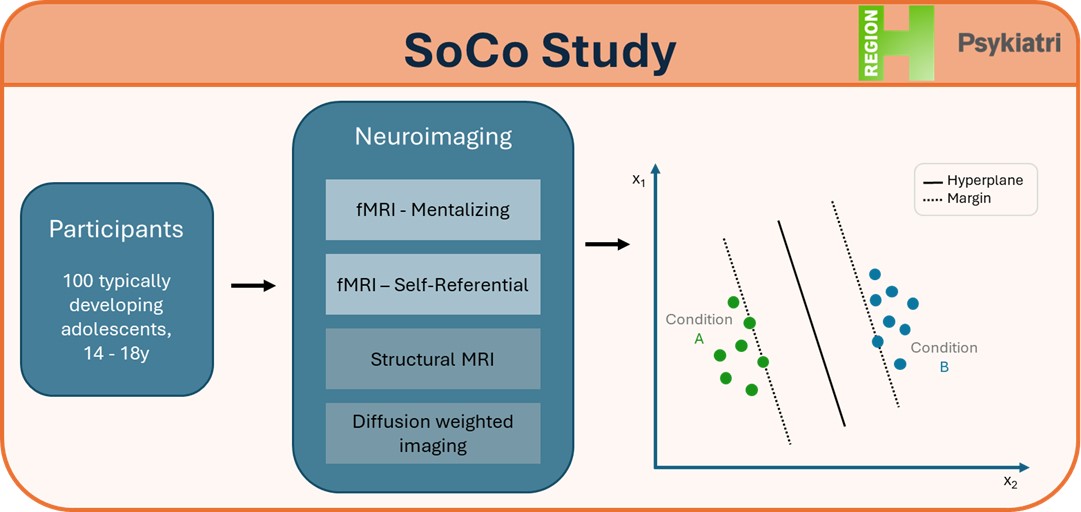
Normative dataset based on 100 typically developing adolescents. Social cognition assessed in task-based fMRI using a mentalizing and a self-referential paradigm. A support vector machine classifier is applied to generate a hyperplane differentiating the BOLD response of two conditions within the social cognition tasks.