



Almost 20 years ago, Mazzoni et al. asked this question, suggesting that much of the motor impairment in Parkinson’s disease (PD) is due to reduced motor motivation, resulting in reduced movement invigoration. https://doi.org/10.1523/JNEUROSCI.0264-07.2007
Since then, the prevailing model of PD motor symptoms has been the following: loss of dopaminergic innervation of the putamen → reduced putamen activity → diminished motor invigoration.
However, this assumption has never been tested assessing putamen denervation, putamen function and motor vigour in the same individuals. This is what we did in our newest study at the DRCMR (on bioRxiv): https://www.biorxiv.org/content/10.64898/2026.09.02.748476v1
We used a Go/Nogo task with grip-force responses testing PD patients with and without levodopa-induced dyskinesia OFF dopamine medication as well as healthy controls (HC).
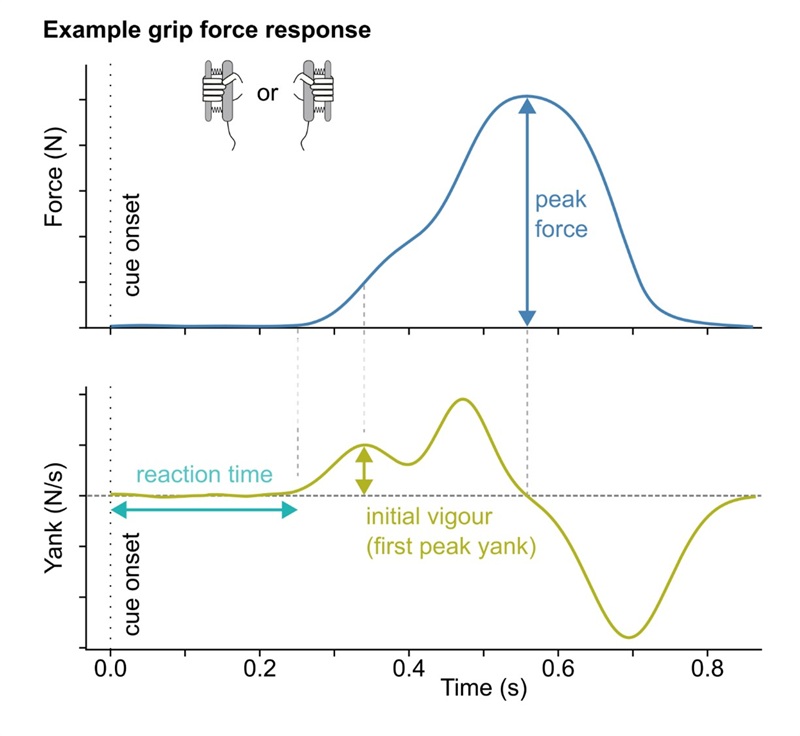
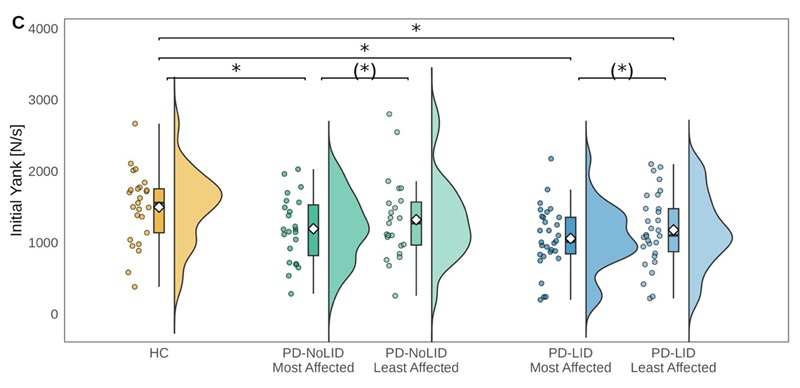
The grip-force devices allowed us to extract precise movement kinematics, and it turned out that initial response invigoration was a sensitive marker for reduced motor invigoration in both PD groups compared to HC.
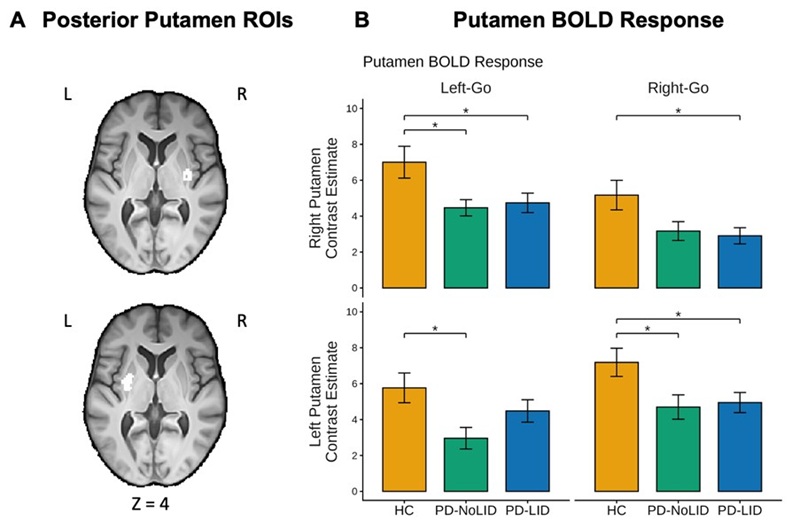
PD patients also showed reduced putamen activity (fMRI) during force generation. Finally, higher dopamine denervation in the putamen (lower PET dopamine transporter binding) was associated with both poorer movement vigour and weaker grip‐related putamen activation.
For the first time, this shows the assumed link between dopamine denervation, functional impairment and resulting vigour impairments in the same individuals in PD.
Additionally, the vigor of a movement is directly coupled to the value of its outcome. We thus added rewards and losses to our task design to test whether reduced motor vigor in PD might be associated with an impaired encoding of losses and rewards linked to the action.
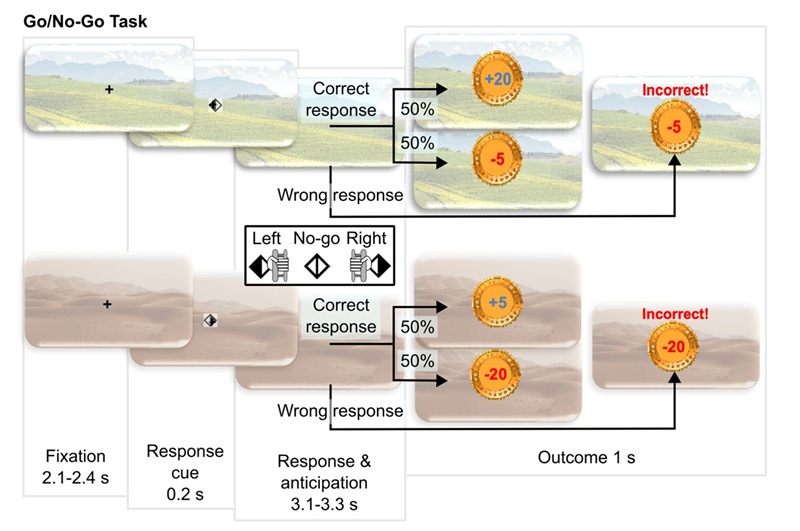
This allowed us to relate the scaling of activity in the reward network to different outcome magnitudes. We observed that this scaling was blunted in the ventral striatum in PD patients.
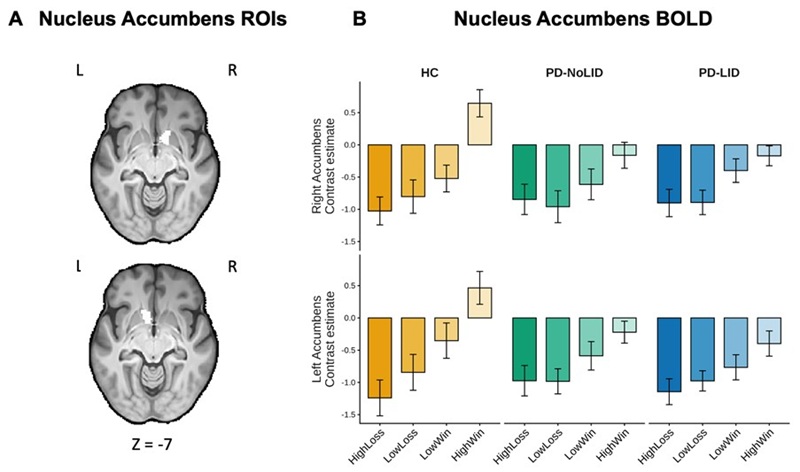
Furthermore, a stronger scaling of reward-related activity in the ventral striatum was associated with greater movement vigour across all groups. This corroborates the idea that motivational aspects play a fundamental role in motor performance.
These findings provide in vivo evidence that nigrostriatal dopaminergic degeneration constrains movement vigour in PD through reduced striatal recruitment during action generation, together with a blunting of reward responsivity in ventral striatum.
PD patients with levodopa-induced dyskinesia showed stronger dopaminergic denervation than those without, yet movement vigour and striatal responses were similar, suggesting that dyskinesia and reduced vigour reflect partly dissociable consequences of nigrostriatal denervation.
This impressive work was driven by PhD student Birgitte L.C. Thomsen, main supervisors Hartwig Siebner and David Meder as well as the invaluable contributions from Vytautas Labanauskas, Nora Raaf, Sune G. Thomsen, Mikkel C. Vinding, Lisbeth Marner and Annemette Løkkegaard.
This project was part of the international collaborative ADAPT-PD project funded by Lundbeckfonden and received additional support from the Danish Parkinson Association, Bjarne Saxhofs Fond, and the Research Fund of the Department of Clinical Medicine.