



Parkinson's disease doesn't only destroy dopamine neurons — it also causes significant loss of noradrenaline-producing neurons in the locus coeruleus (LC). The LC is tiny: only about 3 cm long and the diameter of a spaghetti. Despite its size, it plays a key role in arousal, attention, and many of the non-motor symptoms that profoundly affect quality of life in PD.
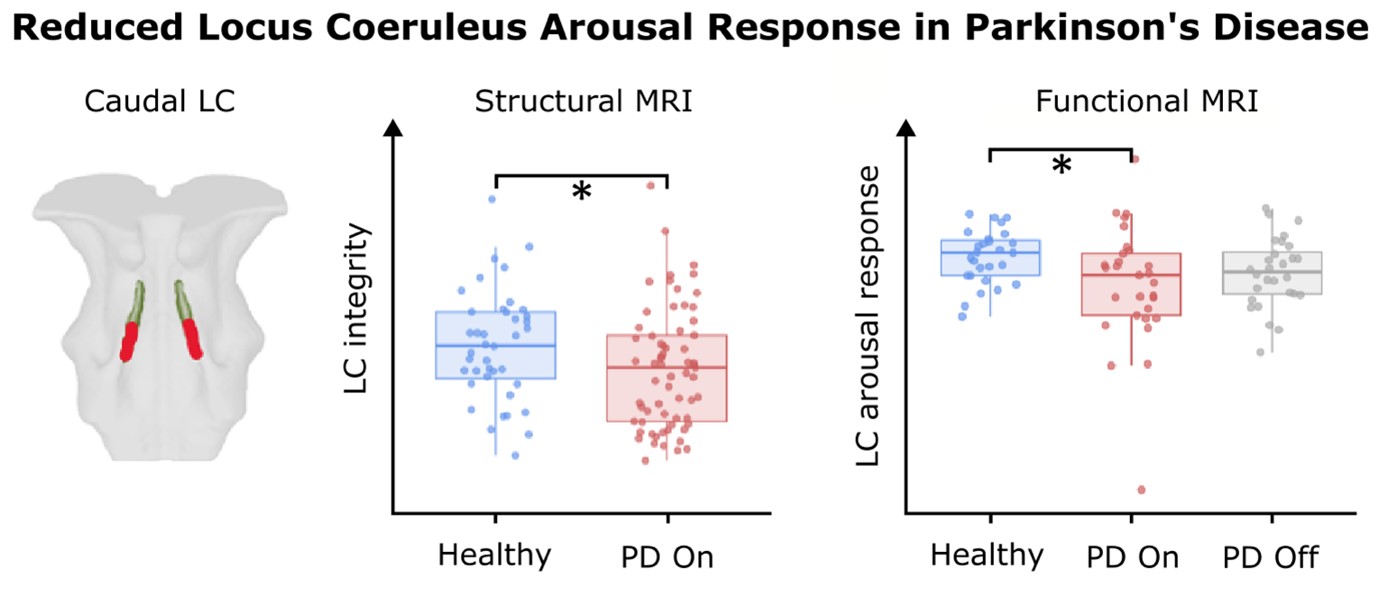
In our new paper out today in Brain, we used a 7T MRI scanner to measure LC function in people with PD for the first time — alongside its structure. We presented surprising loud noises and startling images to activate the noradrenergic arousal system, and found that the LC's response was significantly reduced in PD compared to healthy controls. Crucially, this functional reduction was most pronounced in the caudal (lower) part of the LC — the same region that shows the greatest structural degeneration.
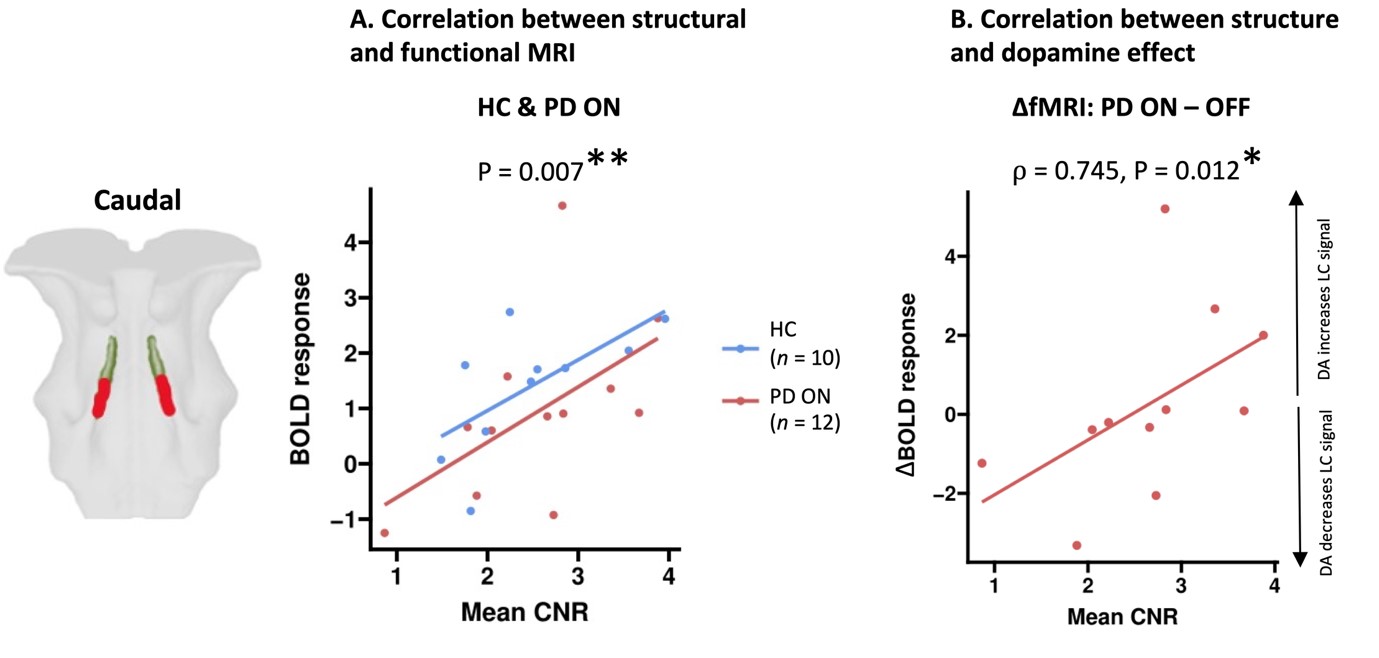
For testing the structure-function relationship at the individual level, because PD progresses continuously, we only analyzed participants where structural and functional scans were acquired within 6 months. This resulted in a small sub-sample (10 HC and 12 people with PD), so there’s low confidence in the following results: We found that lower LC structural integrity correlated with lower LC arousal response. Interestingly, the effect of medication in people with PD depended on LC integrity: If the LC was still relatively intact, medication increased the LC arousal response. If the LC was more degenerated, medication decreased the LC arousal response.
Two findings stand out:
- The hypoactivation persisted even when participants were ON dopaminergic medication, showing that LC dysfunction in PD goes beyond dopamine deficits.
- This points to complex interactions between the dopaminergic and noradrenergic systems. Dopaminergic treatment affects the noradrenergic system and thus most likely numerous non-motor symptoms – but its effects are complex and depend on the LC’s structural integrity.
This work was led by Anders Elkjær Lund, with contributions from Christopher F. Madelung, Kristoffer H. Madsen, Birgitte L. C. Thomsen, and Annemette Løkkegaard, and headed by David Meder and Hartwig R. Siebner. It was made possible by funding from the Independent Research Fund Denmark, the Novo Nordisk Foundation, the Danish Parkinson Association, and the Lundbeck Foundation.
Full paper: https://academic.oup.com/brain/advance-article/doi/10.1093/brain/awag106/8539056