


DRCMR Logo 300px Color
 

Quick start guide to the Bloch Simulator

This page provides step-by-step examples to practical use of the Bloch Simulator made for visualizing basic and advanced Magnetic Resonance techniques. The examples are spin-echo formation and the excitation process, which are also demonstrated in corresponding YouTube videos. The basic MR knowledge needed to understand the text below is described in an MRI tutorial targeted at a broad audience.

  • It is easiest to run the simulator directly in an internet browser. If you have not already started it, please do so by following this link starting the software in a new browser window: http://www.drcmr.dk/BlochSimulator
  • If you have Flash installed on your computer, you should now see the magnetization vector of an imaginary sample precessing in a magnetic field, B0, pointing upwards. You can always get back to this situation by choosing "Scene: Precession" in the pull-down menu on the lower left.
  • First try to adjust the B0 field strength by moving the slider named "B0". Notice how the precession frequency changes with the field. Think of the units as tesla, for example.

Spin-echo demonstration, step by step:
The spin echo sequence
  • Now, let's introduce field inhomogeneity so that all nuclei do not precess at the same frequency. This can be done by choosing "Scene: Weak inhomogeneity" in the pull-down menu on the lower left. You now see the magnetization in thermal equilibrium. The floor rotates since you see this in the rotating frame of resonance which is only needed later. Therefore, shift back to the stationary frame by pressing the  "Change frame"-button.
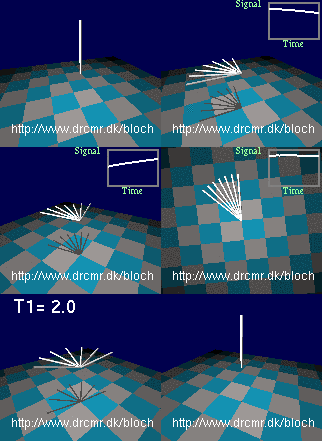
  • Since weak inhomogeneity was selected above, the nuclei precess at different frequencies, but it does not show until the magnetization is rotated into the transversal plane. Do this by pressing the "90x hard" button (initiates 90 degree RF pulse rotating the magnetization quickly around the x-axis in the transversal plane). You should now see different components of the magnetization precessing at slightly different frequencies. Gradual dephasing leads to a loss of signal seen in the lower right graph. Press the "v" key on keyboard a few times - it toggles the viewing angle.
  • You may want to repeat the last few steps by pressing the "Scene: Weak inhomogeneity" button again and doing a new excitation. Proceed when you understand what you are seeing so far. Let's add a short 180 degree refocusing pulse to our sequence after some dephasing has occurred (press the "180y hard"-button). This will lead to the formation of a spin-echo after a period equal to the dephasing period. Notice how the nuclei get back in phase and how the lost signal is recovered.
  • This finishes the spin-echo demonstration, but you can continue experimenting with it, e.g. by playing out extra refocusing pulses or by adding a bit of relaxation using the T2-slider for example (choose a large value for T2 initially, e.g. 20 seconds). You can also watch the events in the rotating frame of resonance.

Off- and on-resonance excitation, step by step:

  • Go back to the initial situation by  choosing "Scene: Precession" in the pull-down menu on the lower left.
  • Adjust the B0 field strength by moving the slider named "B0". Notice how the precession frequency changes with the field. Set the value of B0 back to 3 by typing the value in the text field above the slider, followed by "enter". Think of the units as tesla, for example.
  • Radio waves applied off-resonance
    Radio waves applied off-resonance
    Now turn on a radio wave field. Do this by setting the RF amplitude to 0.1 using the appropriate slider or by typing the value in the corresponding text field, followed by "enter". The units are the same as for the B0 field. The red bar shows the push of the radio waves on the magnetization (the torque). Notice how the push is orthogonal to the magnetization, and how it rotates.
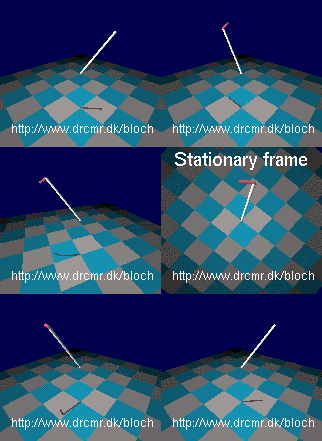
  • The push does not seem to have much of an effect on the magnetization. This is because the frequency of the radio waves is not matched to the Larmor frequency (the radiowaves are off-resonance). The reason for the missing effect may be easier to see in the rotating frame of reference. Press "Change frame" to toggle between viewing in the stationary and the rotating frames of reference as you wish. Notice how the magnetization is not pushed consistently by off-resonance radiowaves (in synchony with the precession). Therefore it just wiggles slightly in the radio wave field. Switch back to the stationary frame of reference.
  • Adjust the radio frequency to match the Larmor frequency simply by setting the RF frequency equal to B0 (3 in this case). This is valid since the gyromagnetic ratio in the simulator is set to 1 Hz/T (approximately). Hence the resonance frequency for a field of value 3 is simply 3. Notice how the magnetization is now gradually changed by the RF field. Watching this in the rotating frame makes it appear much simpler -- switch back and forth a few times, and notice how resonance radiowaves induces rotations in the rotating frame of reference.
  • Radio waves applied on resonance
    Radio waves applied on resonance
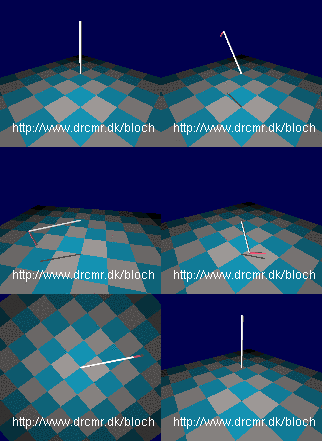
    Now you have seen how resonant radiowaves change the magnetization, and how off-resonant waves does not, lets start from equilibrium and do an excitation. Choose "Scene: Equilibrium". Add an RF field by setting the RF amplitude equal to 0.1. Notice how little happens since the RF frequency is not adjusted to the Larmor frequency. Adjust it as described above and see how the magnetization is rotated away from equilibirum, e.g. so it after a while points in the exact opposite directions. Similarly, on-resonance rotations away from equilibrium can be triggered by pressing the buttons labelled "90x hard", "90x selective", "180y hard" and "30x hard" that send bursts of radiowaves sufficiently long to cause the specified rotations.

The simulator can do much more. A few examples are given in YouTube videos and on the project homepage but you really need to experiment yourself to get full benefit. The "Challenges" section in the "Help" menu may also be of inspiration.
 

This page provides step-by-step examples to practical use of the Bloch Simulator made for visualizing basic and advanced Magnetic Resonance techniques. The examples are spin-echo formation and the excitation process, which are also demonstrated in corresponding YouTube videos. The basic MR knowledge needed to understand the text below is described in an MRI tutorial targeted at a broad audience.

  • It is easiest to run the simulator directly in an internet browser. If you have not already started it, please do so by following this link starting the software in a new browser window: http://www.drcmr.dk/BlochSimulator
  • If you have Flash installed on your computer, you should now see the magnetization vector of an imaginary sample precessing in a magnetic field, B0, pointing upwards. You can always get back to this situation by choosing "Scene: Precession" in the pull-down menu on the lower left.
  • First try to adjust the B0 field strength by moving the slider named "B0". Notice how the precession frequency changes with the field. Think of the units as tesla, for example.

Spin-echo demonstration, step by step:

The spin echo sequence
  • Now, let's introduce field inhomogeneity so that all nuclei do not precess at the same frequency. This can be done by choosing "Scene: Weak inhomogeneity" in the pull-down menu on the lower left. You now see the magnetization in thermal equilibrium. The floor rotates since you see this in the rotating frame of resonance which is only needed later. Therefore, shift back to the stationary frame by pressing the  "Change frame"-button.
  • Since weak inhomogeneity was selected above, the nuclei precess at different frequencies, but it does not show until the magnetization is rotated into the transversal plane. Do this by pressing the "90x hard" button (initiates 90 degree RF pulse rotating the magnetization quickly around the x-axis in the transversal plane). You should now see different components of the magnetization precessing at slightly different frequencies. Gradual dephasing leads to a loss of signal seen in the lower right graph. Press the "v" key on keyboard a few times - it toggles the viewing angle.
  • You may want to repeat the last few steps by pressing the "Scene: Weak inhomogeneity" button again and doing a new excitation. Proceed when you understand what you are seeing so far. Let's add a short 180 degree refocusing pulse to our sequence after some dephasing has occurred (press the "180y hard"-button). This will lead to the formation of a spin-echo after a period equal to the dephasing period. Notice how the nuclei get back in phase and how the lost signal is recovered.
  • This finishes the spin-echo demonstration, but you can continue experimenting with it, e.g. by playing out extra refocusing pulses or by adding a bit of relaxation using the T2-slider for example (choose a large value for T2 initially, e.g. 20 seconds). You can also watch the events in the rotating frame of resonance.

Off- and on-resonance excitation, step by step:

  • Go back to the initial situation by  choosing "Scene: Precession" in the pull-down menu on the lower left.
  • Adjust the B0 field strength by moving the slider named "B0". Notice how the precession frequency changes with the field. Set the value of B0 back to 3 by typing the value in the text field above the slider, followed by "enter". Think of the units as tesla, for example.
  • Radio waves applied off-resonance
    Radio waves applied off-resonance
    Now turn on a radio wave field. Do this by setting the RF amplitude to 0.1 using the appropriate slider or by typing the value in the corresponding text field, followed by "enter". The units are the same as for the B0 field. The red bar shows the push of the radio waves on the magnetization (the torque). Notice how the push is orthogonal to the magnetization, and how it rotates.
  • The push does not seem to have much of an effect on the magnetization. This is because the frequency of the radio waves is not matched to the Larmor frequency (the radiowaves are off-resonance). The reason for the missing effect may be easier to see in the rotating frame of reference. Press "Change frame" to toggle between viewing in the stationary and the rotating frames of reference as you wish. Notice how the magnetization is not pushed consistently by off-resonance radiowaves (in synchony with the precession). Therefore it just wiggles slightly in the radio wave field. Switch back to the stationary frame of reference.
  • Adjust the radio frequency to match the Larmor frequency simply by setting the RF frequency equal to B0 (3 in this case). This is valid since the gyromagnetic ratio in the simulator is set to 1 Hz/T (approximately). Hence the resonance frequency for a field of value 3 is simply 3. Notice how the magnetization is now gradually changed by the RF field. Watching this in the rotating frame makes it appear much simpler -- switch back and forth a few times, and notice how resonance radiowaves induces rotations in the rotating frame of reference.
  • Radio waves applied on resonance
    Radio waves applied on resonance
    Now you have seen how resonant radiowaves change the magnetization, and how off-resonant waves does not, lets start from equilibrium and do an excitation. Choose "Scene: Equilibrium". Add an RF field by setting the RF amplitude equal to 0.1. Notice how little happens since the RF frequency is not adjusted to the Larmor frequency. Adjust it as described above and see how the magnetization is rotated away from equilibirum, e.g. so it after a while points in the exact opposite directions. Similarly, on-resonance rotations away from equilibrium can be triggered by pressing the buttons labelled "90x hard", "90x selective", "180y hard" and "30x hard" that send bursts of radiowaves sufficiently long to cause the specified rotations.


The simulator can do much more. A few examples are given in YouTube videos and on the project homepage but you really need to experiment yourself to get full benefit. The "Challenges" section in the "Help" menu may also be of inspiration.
 

Recent Publications

Beha GH, Stemmerik MG, Boer VO, van der Ploeg AT, van der Beek NAME, Andersen H, Marsman A, Jacobsen LN, Theunissen MTM, Petersen ET, Vissing J. 2025. Quantification of muscle glycogen distribution in Pompe disease using 7 Tesla 13C NMR spectroscopy. JNNP. Accepted.

Güler S, Zivkovic I, Boer VO, Zhurbenko V, Petersen ET. 2025. The mode of operation of high-impedance coils and shielded coaxial cable coils: A comparative study. NMR Biomed. 38(8): e70071. https://doi.org/10.1002/nbm.70071

London A, Schaufuss A, Povazan M, Dichman M-L, Merhout J, Dirksen C, Madsbad S, Siebner HR, Lundsgaard A, Fritzen AM, Kiens B, Bojsen-Møller KN. 2025. Effects of acute iso- and hypocaloric carbohydrate restriction on liver fat and glucose and lipid metabolism. J Clin Endocrinol Metab. dgaf382, https://doi.org/10.1210/clinem/dgaf382

Güler S, Povazan M, Zhurbenko V, Zivkovic I. 2025. An 8Tx/32Rx head-neck coil at 7T by combining 2Tx/32Rx Noval coil with 6TRx shielded coaxial cable elements. Magn Reson Med. 93(2): 864-872. https://doi.org/10.1002/mrm.30297

Madelung CF, Løkkegaard A, Fuglsang SA, Marques MM, Boer VO, Madsen KH, Hejl A-M, Meder D, Siebner HR. 2025. High-resolution mapping of substantia nigra in Parkinson’s disease using 7 tesla magnetic resonance imaging. Npj Parkinsons Dis. 11(113). https://doi.org/10.1038/s41531-025-00972-7

London A, Richter MM, Sjøberg KA, Wewer Albrechtsen NJ, Povazan M, Drici L, Schaufuss A, Madsen L, Øyen J, Madsbad S, Juul Holst J, van Hall G, Siebner HR, Richter EA, Kiens B, Lundsgaard A, Bojsen-Møller KN. 2024. The impact of short-term eucaloric low- and high-carbohydrate diets on liver triacylglycersol content in males with overweight and obesity: a randomized crossover study. Am J Clin Nutrition. 120(2): 283-293. https://doi.org/10.1016/j.ajcnut.2024.06.006

Madsen MAJ, Povazan M, Wiggermann V, Lundell H, Blinkenberg M, Romme Christensen J, Sellebjerg F, Siebner HR. 2024. Association of cortical lesions with regional glutamate, GABA, N-Acetylaspartate, and Myoinositol levels in patients with multiple sclerosis. Neurology. 103(1): e209543. https://doi.org/10.1212/WNL.0000000000209543

Stærkind H, Jensen K, Müller JH, Boer VO, Polzik ES, Petersen ET. 2024. High-field optical cesium magnetometer for magnetic resonance imaging. PRX Quantum. 5(2): 020320. https://doi.org/10.1103/PRXQuantum.5.020320

Stærkind H, Jensen K, Müller JH, Boer VO, Petersen ET, Polzik ES. 2023. Precision measurement of the excited state Landé g-factor and diamagnetic shift of the Cesium D2 line. Phys Rev X. 13(2): 021036. https://doi.org/10.1103/PhysRevX.13.021036

Boer VO, Pedersen JO, Arango N, Kuang I, Stockmann J, Petersen ET. 2022. Improving brain B0 shimming using an easy and accessible multi-coil shim array at ultra-high field. MAGMA. 35(6): 943-951. https://doi.org/10.1007/s10334-022-01014-6

Andersen M, Laustsen M, Boer V. Accuracy investigations for volumetric head-motion navigators with and without EPI at 7 T. 2022. Magn Reson Med. 88(3): 1198-1211. https://doi.org/10.1002/mrm.29296

Madsen MAJ, Wiggermann V, Marques MFM, Lundell H, Cerri S, Puonti O, Blinkenberg M, Romme Christensen J, Sellebjerg F, Siebner HR. 2022. Linking lesions in sensorimotor cortex to contralateral hand function in multiple sclerosis: a 7 T MRI study. Brain. 145(10): 3522-3535. https://doi.org/10.1093/brain/awac203

Sandström KO, Baltzersen OB, Marsman A, Lemvigh CK, Boer VO, Bojesen KB, Nielsen MØ, Lundell H, Sulaiman DK, Sørensen ME, Fagerlund B, Lahti AC, Syeda WT, Pantelis C, Petersen ET, Glenthøj BY, Siebner HR, Ebdrup BH. 2022. Add-on memantine to dopamine antagonism to improve negative symptoms at first psychosis – the AMEND trial protocol. Front Psychiatry. 13: 889572. https://doi.org/10.3389/fpsyt.2022.889572

Madelung CF, Meder D, Fuglsang SA, Marques MM, Boer VO, Madsen KH, Petersen ET, Hejl A-M, Løkkegaard A, Siebner HR. 2022. Locus coeruleus shows a spatial pattern of structural disintegration in Parkinson’s disease. Movement Disord. 37(3): 479-489. https://doi.org/10.1002/mds.28945


Selected Recent Conference Abstracts

Engel K, Wiggermann V, Ronen I, Lundell H. Correction of phase fluctuations in diffusion-weighted MRS at high b-values with external phantom reference. ISMRM annual meeting. 05/2025,

Madsen MAJ, Christiansen L, Povazan M, Wiggermann V, Siebner HR. Regional glutamate but not GABA concentration scales with TMS-based measures of cortical excitability – a combined 7T MR spectroscopy and TMS study of the human primary motor hand area. Brain Stimulation, Kyoto, Japan, 02/2025 [Brain Stimulation 18(1) 576, 2025]

Madsen MAJ, Wiggermann V, Lundell H, Christiansen L, Romme Christensen J, Blinkenberg M, Sellebjerg F, Siebner HR. The impact of pathway-specific cortical and white matter pathology on trans-callosal conduction and inhibition in multiple sclerosis, ECTRIMS, Copemhagen, Denmark, 09/2024

Madsen MAJ, Wiggermann V, Christiansen L, Povazan M, Lundell H, Puonti O, Romme Christensen J, Sellebjerg F, Siebner HR. The ipsilateral silent period and its link to cortical lesions in multiple sclerosis, Brain Stimulation, Lisbon, Portugal, 02/2023, [Brain Stimulation 14(6) 1628, 2023]

Stemmerik M, Beha G, Boer V, Marsman A, Jacobsen L, Petersen E, Vissing J. 2022. Using high-field magnetic resonance spectroscopy to measure muscle glycogen in patients with McArdle disease. Neuromuscular Disorders. 32. S73-S74.

Beha G, Stemmerik M, Boer V, Marsman A, Jacobsen L, Petersen E, Vissing J. 2022. Quantification of glycogen distribution in late-onset Pompe patients using 7 Tesla C13 NMR spectroscopy. Neuromuscular Disorders. 32. S73.

Madsen MAJ, Wiggermann V, Povazan M, Lundell H, Boer VO, Marsman A, Blinkenberg MB, Romme Christensen J, Sellebjerg FT, Siebner HR. 2022. Linking cortical demyelination to changes in brain metabolism in multiple sclerosis: a 7T MR spectroscopy study. ECTRIMS annual (virtual) meeting.

Güler S, Costa G, Boer V, Paulides M, Baltus P, Petersen E, Zivkovic I. 2022. Shielded coaxial cable coils: the array configuration for maximized central SNR at 7T MRI. Joint Annual Meeting ISMRM-ESMRMB, 31st annual ISMRM meeting.

Güler S, Zhurbenko V, Zivkovic I, Boer V, Petersen ET. 2022. Second resonance mode ensure intrinsic low coupling between elements on shielded-coaxial-cable coil designs. Joint Annual Meeting ISMRM-ESMRMB, 31st annual ISMRM meeting.

Group Members

Vanessa Wiggermann

Group Leader

Henrik Lundell

Group Leader

Lars G. Hanson

Sebastian Ladegaard Storm

Paul Wessel de Bruin

Ahmed Ibrahim Al-Rahimi

Show all group members (22)

External Collaborators

Jeroen Hendrikse

Department of Radiology, University Medical Center Utrecht, The Netherlands


Dennis Klomp

Department of Radiology, University Medical Center Utrecht, The Netherlands


Andrew Webb

Department of Radiology, Leiden University Medical Center, The Netherlands


Matthias van Osch

Department of Radiology, Leiden University Medical Center, The Netherlands


Itamar Ronen

Department of Radiology, Leiden University Medical Center, The Netherlands


Karin Markenroth Bloch

Swedish National 7T facility, Lund, Sweden


Gunther Helms

Swedish National 7T MRI Facility, Medical Radiation Physics, Lund, Sweden


Kirsten Borup Bojesen

Center for Neuropsychiatric Schizophrenia Research, Mental Health Services, Capital Region of Denmark, Denmark